
What I Learned from Interviewing People Braver Than Me

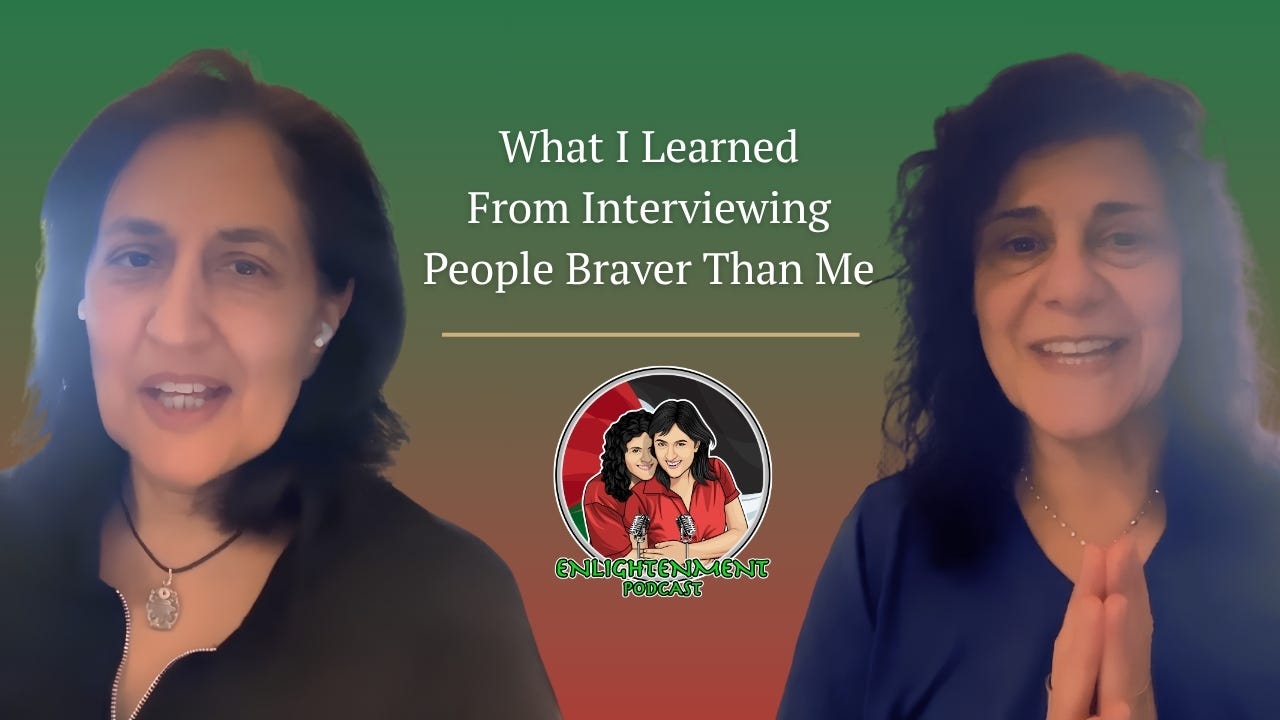
If you don’t know that I co-host a podcast (The Enlightenment Podcast, since you ask), let me set the scene. Hanan and I are two women who have, between us, made films, run companies, raised extremely intelligent (read ‘incorrigible’) boys, and held opinions firm enough to get us removed from several WhatsApp groups. Yet, somehow, nine minutes before a podcast guest is due to pop onto our screens, we are fully defeated by the recording software. You know what? I lie - it’s just me that’s defeated, crushed, personally mocked by the software.
Behind the Scenes
Hanan’s work on the podcast takes days longer than mine. She researches, reads, creates the questions and co-presents. My job is mostly just to produce the podcast on the day, and just to clarify: ‘produce’ is a fancy word for being the IT department, and let’s just say the IT department is having a rough morning. On this occasion, we’re travelling, and the only fibre in our accommodations appear to be in the Weetabix and not the wifi cable. To add to my stress, Descript is convinced our guest is in the waiting room but it’s also telling me the waiting room is empty. My mic won’t turn on. As I watch the seconds tick down till we are due to start, I lose any ability to be rational and just start clicking things. I have never known what these things do, but maybe it’s time to find out. Somewhere, in another browser tab, Descript is transcribing my panicked muttering, including cursing in all the languages I know, with total accuracy and zero mercy.
Meanwhile, in another room, Hanan has discovered that she hates her background. She always hates her background.
‘Does this plant look like its dying?’ she wants to know. ‘No, I AM DYING,’ I want to say, but I run in and shove the plant into a corner. Hanan regards her screen again. ‘Maybe now this wall just looks depressing?’
She’s not wrong. The wall is now empty and grey and makes her look like she’s recording a proof-of-life video from a dodgy basement somewhere. I drag a floor lamp in behind her. ‘Better?’ I ask, suppressing my hysteria. No. We move it back.
‘Better?’ I ask again, but I no longer know what ‘better’ even means. By the time our esteemed guest’s face actually appears on screen — calm, composed, ready — I have sweated cleanly through my shirt and aged at least a year, and truly, I can’t afford to shave off a year at a time, not at this age. Hanan glances at me, red-cheeked, face scrunched in mental anguish, and asks if, next time, I could make a tad more effort in my personal appearance. You know, since I’m presenting this thing with her? I nod, helpless.
There’s a bit of chit chat, before we start taping, during which I get back on my game. And then the guest starts speaking. The Enlightenment Podcast gives time to Palestinians and those working with and supporting Palestinians – accomplished writers, artists, doctors, aid providers, historians, activists, lawyers, who often get just a soundbite on mainstream media, and even then, they’re sometimes forced to confront people from ‘the other side’ who shout them down.
Not on our podcast. Stories, for us, are everything, and those who are doing extraordinary things usually have quite the life history to share. They start to answer Hanan’s incisive, gentle question. We start to hear about where they are from, what they’ve seen, the life events that shaped them. One of them has faced down armed, aggressive soldiers more times than they would have wanted. Another has been jailed for the crime of reporting accurately. Another has held dying babies in Gaza, not because they were mortally wounded, but because the formula he brought in his suitcases was confiscated by IDF soldiers at the border. And there I am, freshly traumatised by Descript, thinking ‘Could I have done that?’
Our podcast with Ahed Tamimi finished me off. If you don’t know the name, you know the photograph: a slight teenage girl with a curly ponytail and a face full of fury, fist raised at an Israeli soldier in full armour and a machine gun who dared threaten her family. Ahed looks fierce, and the soldier looks, frankly, unsure of how this is going to go.
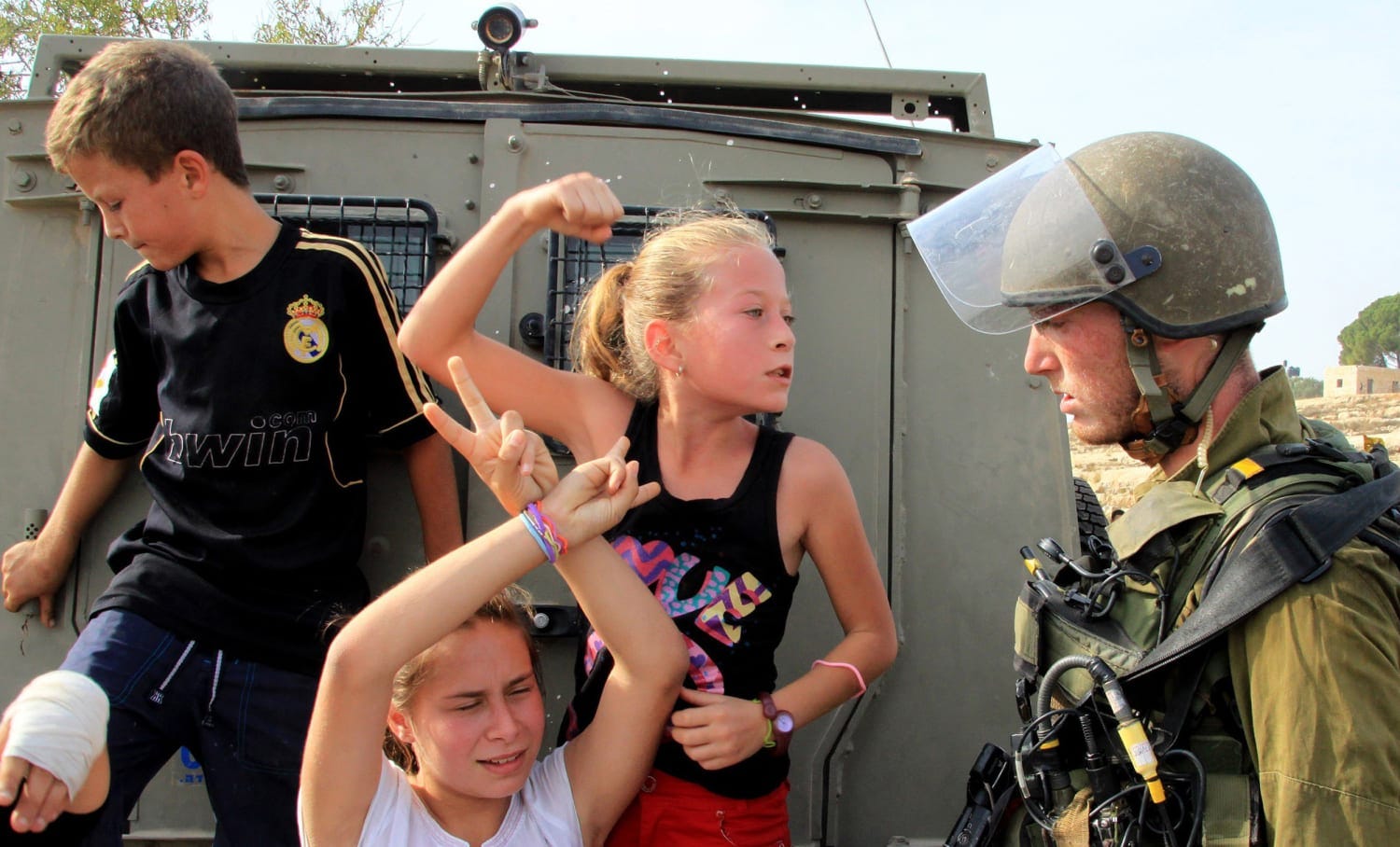
She became a global symbol of Palestinian resistance before she was old enough to drive, essentially by refusing to be pushed into fear. In my mid-teens, I also raised an arm, but in a classroom, and only halfway and then, the instant the (admittedly scary) teacher looked up, I converted it smoothly into scratching my head. Same arm. Wildly different stakes. Even now, I have to pluck up the grit to confront an arsey waiter about bringing me the thing I actually ordered.
I always listen carefully as we tape this podcast, immersing in our guests’ fascinating worlds (and yes, obsessively checking the red dot is flashing or whatever); but sometimes I also quietly audition myself for their roles, and face the fact that I’d never get the part. It took me some time to get over this knowledge, but then I figured out that maybe I shouldn’t be trying to audition at all.
You see, I’d been picturing bravery as a scene. I’m a filmmaker and also, Hollywood colonised my youth; of course, I imagined it as a scene. Beautifully-lit, by the way, maybe even a touch of flaring sunset in the corner of the shot, achingly-scored, a real ‘moment’ — the soldiers taunting, the line you refuse to cross, the slow push-in on the defiant eyes. It’s all thrillingly dramatic. The problem with imagining courage as a series of filmic shots, though, is that you can end up spending your whole life waiting in your trailer, for someone to knock and ask you to be in a scene that, really, you never, ever, want to actually appear in. Nobody has taken my home, food, water. Nobody’s asking me to amputate a limb without anaesthesia. The fiercest terror I face on an average weekday is a spider in the bath and, trust me, I whinge like a brat till Hanan can catch it and throw it outside.
But this is what the guests kept telling me, in different ways and about various catastrophes: there is no ‘scene’. Ahed didn’t stand there weighing her options like an actor nuancing a performance. By the time the soldiers were in front of her, the decision had already been made — months earlier, and a thousand times over, on every ordinary day she refused to pretend the thing in front of her wasn’t happening. The ‘moment’ I kept fixating on was just the part that got filmed. The tip of an iceberg with a whole sea of valour underneath, larger and more hidden, formed and hardened by constant, relentless apartheid and attempted degradations, day after day after day.
Dr Ghassan Abu Sittah and Dr Nick Maynard are surgeons who keep heading back into Gaza to operate, again and again, to put people back together under bombardment with whatever is left in the room, in whatever is left of the buildings. And it’s not much as over 90% of the aid trucks agreed under the ‘ceasefire’ have not been let in.
On another plane entirely, Vivien Sansour saves seeds. Which sounds like a dream, until you understand that this is a woman moving heaven and (literal) earth to bet on a harvest she may never see; preserving the ancient, heirloom varieties of a homeland that is being stolen from under her, precisely because Israel is doing everything it can to take them, or erase them and often replace them, with European plants as well as poisoning wells and burning olive groves. Two of these heroes run toward the catastrophe; the other diligently preserves life in its smallest form as a gesture of care and resilience. All are people who’d decided, long before any camera turned up, long before we interviewed them, which way they were going to face.
All of this is kind of a problem. Because, as long as bravery was a Moment, I got to hold onto the lovely private fiction that I’d rise to it when it came. When it counted, I would be there. But if there’s no single Moment, if it’s all just ordinary days, and small decisions about whether to look away; then I don’t get to wait to be tested. I’m being tested constantly. Was I failing the test on my own for years, quietly? Yes, maybe. But I think, these days, less than before.
I am not about to face down a soldier (yet, and I hope ever). But brave people all over the U.K. have faced down the Met Police and gotten arrested simply for peacefully protesting a genocide. So, the stakes seem higher than ever in our relatively privileged parts of the world. The lines of ‘democracy’ are blurring before I eyes, and free speech seems to be fine if you’re trashing immigrants but not if you’re standing up for Palestine. Maybe this is the one-step removed, retail version of bravery but it matters. It also stops letting you off the hook, because without all of us adding something – even one, small, bit to this process, to this protest - the system will do what it always does and chew up and spit out millions who, like us, deserve a peaceful life
It felt, for a while, as if the podcast was the easy, less feisty option; handing a microphone to people who’d actually risked something while I fiddled with the sodding software from the safety of my own house. But it at least gives these people a voice in a world where mainstream news gives the platform to those who checked their morals at Jeffrey Epstein’s door decades ago. The podcast is a refusal to look away, scheduled weekly, presented (sometimes) in a damp shirt.
And if you yourself haven’t got a podcast to perspire through, take heart: the possibilities for jumping into connection with the world, for starting to create it as it should be, are everywhere, and mostly free. It’s the thing you finally say to the relative who has once more complained about ‘immigrants’ over the roast chicken, instead of stress-eating another potato. It’s the three irritating minutes it takes to make yet another shopping account and invent yet another password you’ll forget by Thursday, so that your tea, or your sofa, comes from someone — anyone — not ultimately owned by Amazon and BlackRock and the handful of funds that would quite like the world kept exactly as profitable and miserable as it currently is. None of it is heroic. It just takes a tad more time and energy.
The default is frictionless on purpose. They want it that way. They want you unable to take a moment to reject the default. Don’t accept.
So for me and (I hope) for you - no soldiers, no scene. Just sometimes, other than a podcast, and social media, and donating to those doing incredible work in the field, there’s a keffiyeh, which I wear on set.
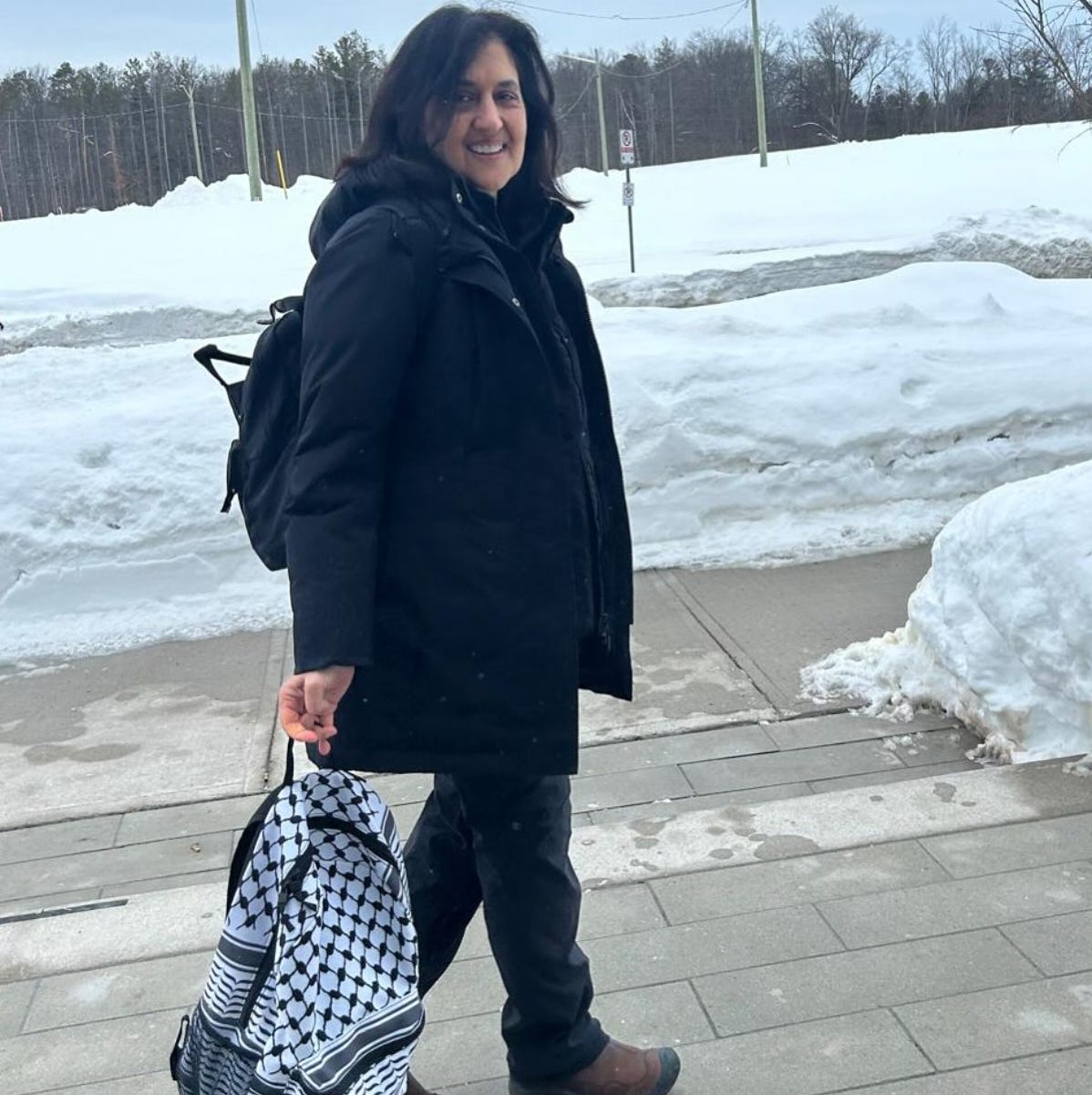
It is, I promise you, the least dramatic object on a film set filled with costume, lights and props. But when I walk onto the floor wearing it, I can feel the room quietly sort itself into those who hold your eye, a few who give the small nod, and a few who develop an intense new interest in the gaffer tape. Once in a while, sadly, one who is thinking ‘I’m not hiring her again’. It costs me almost nothing. Almost. Turns out that this “almost” is the whole of it — the difference between a Coca-Cola or a Starbucks I can refuse, and a scarf I keep wearing into the room, in front of people who’d just rather I didn’t, as we turn the cameras onto other people. Not brave, by any stretch of the imagination. Just facing the right way, and standing tall.
Shamim
Good article. But consider that what is dubbed peaceful co-existence at the global level and quotidian monotony at the individual level is actually the ultimate weapon. Is the final end-game of Gaza not to spread this deterrence and neutrality of the west to the last places which harbour intensity, stakes, and a dialectical culture? Perhaps Trump's Board of Peace is not as much of a misnomer as we would like to hope, for it reflects more about our current situation than we are comfortable with. The movement from domination to hegemony is the final straw, the inarguable end-game where we all become both victim and oppressor. The ideology of Human Rights (physical existence, food, water, shelter) is spread part and parcel with the entry into hypercapitalist social relations. Rights may be gained, reality will be lost.
Sadists along the way who take advantage of the capitalist tide might be functioning as the perfect mask for a much more disturbing and much less visible power game.